
Issue # 57 – Special Edition: July 2026 Wanganui Corporation Tramways Electric Tram Trailer No.21
The story of No.21’s arrival at MOTAT, the restoration stages and launch for use on the tramway.

Includes Wanganui Corporation Tramways’ ‘California Combination’ tram No.10 and Gonville and Castlecliff Tramway Board’s steam motor No.100.

Introduction
Whanganui* was one of four provincial cities that operated electric trams in the first half of the twentieth century. Wanganui Corporation Tramways [WCT] began public service on Friday 11th December 1908 and ceased on Sunday 24th September 1950 when the last tram ran from Castlecliff to the city terminus. On Friday 15th September 1950, a Cavalcade of Transport parade was held in which steam motor No.100 towed the two remaining electric tram trailers, Nos. 20 & 22, along Victoria Avenue to mark the passing of the trams and introduction of buses. On Saturday 16th September 1950, No.100 ran again with the trailers and rides given to eager members of the public of all ages.
This special edition of The Squeaky Wheel looks at three of the trams that operated in Wanganui between 1910 and 1950 and are now in the MOTAT Collection. Baldwin built steam motor No.100 first saw service in Wanganui in 1911 when it was used by the contractors building the tramway from Gonville to Castlecliff for the Gonville and Castlecliff Tramway Board. Wanganui Corporation Tramways’ ‘California Combination’ tram No.10 entered service on 6th March 1912 and remained available until closure on 24th September 1950. Wanganui Corporation Tramways’ electric tram ‘convertible trailer’ No.21 entered service 17th October 1922 and was withdrawn soon after WW2. No.21 was built by Boon and Company of Christchurch as one of the second batch of electric tram trailers that WCT ordered. It is known as a “convertible trailer” which means that it can be converted from an enclosed trailer to a semi-enclosed trailer or an open trailer. This is done by having window sections and lower panel sections that slide up into the roof space. Leave both window and lower panels in place gives an enclosed trailer, moving the window sections up into the roof space gives a semi-enclosed trailer and moving both the window sections and lower panel sections up into the roof space gives a fully open trailer in what is known as a “toast-rack” style.
*At the time when trams were in operation in Whanganui the Corporation’s name was Wanganui Corporation Tramways and so all references to their trams and tramway operation will be referred to as Wanganui.
o o o O O O o o o
Wanganui Corporation Tramways’ electric tram trailer No.21
This is the only known photo of convertible tram trailer No.21. Look closely at the numbers – No.21 is lurking in the background on the right inside the car barn in Wanganui.
The most interesting thing about this photo is that it has unintentionally captured the three Wanganui Corporation Tramways tramcars that have made it to preservation: Nos. 10 and 12, both electric California Combination cars, and No.21.


Life in retirement. No.21 as found on a rural property in Turakina, south of Whanganui.
To the best of our knowledge No.21 had already left the Corporation’s depot by 1950. It was not present for the final week celebrations.

After arriving at MOTAT in 1967 No.21 was stored outside for a number of years before being moved to covered storage at the old government stores buildings at Sylvia Park - now a large shopping complex. Transporting tram bodies is no easy task requiring articulated tractor and trailer units and careful strapping down to secure the load. Here we see No.21 about to leave Sylvia Park on its way to MOTAT’s Western Springs site.

In storage at MOTAT
Prior to MOTAT obtaining the body it had been painted green and white.
Prior to its dismantling in c1980: this image

shows the badly deteriorated condition of the
original bodywork. The ravages of rainwater ingress, blocked drains, and lack of movement are all evident in soft and dry rot.
When the initial efforts to dismantle the body were started by the MOTAT tramway team and the PEP works scheme, it was said that the body fell apart more than it was able to be dismantled. (PEP – Project Employment Programme was a government funded scheme for the unemployed from 1980 to 1986. PEP workers were employed on council or other community work programmes).

July 2006, No.21 is back at MOTAT but still a long way off receiving any coachwork attention. This is how the present team ‘received’ the project – a flat packed puzzle of parts. Rotted, composted, borer-ridden halves, quarters or even remnants were all we had to start with, plus a chassis that had had a replacement plywood floor put on. Over the years No.21 has been a much travelled tram: Arrived in 1967 at MOTAT from Turakina and stored outside at M1. No.21 was then moved to storage at Sylvia Park, then back to MOTAT when No.21 was disassembled. Not long after disassembly No.21 was moved to off-site storage again and returned to MOTAT in 2006.

March 2011. Bruce Pullar, Paul Gourley,
Leyton Chan attempt to piece together the remnants of the trailer’s roof structure. No original timbers in the roof were salvageable.
Timber species used here were Douglas fir for the cant rails; American white ash for the roof bows, and filler pieces, New Zealand kauri for ceiling panel droppers, New Zealand totara for the monitor roof bows

June 2012. Tony Messenger and Leyton Chan make a start on setting out the two projects – running gear (i.e. a 4-wheel truck), and the body. Both of these were to be virtually constructed from scratch.
For the chassis, only the intercostal timbers were able to be re-used. The main chassis timbers (tallowwood) were too heavily modified by the PEP works scheme to be re-useable. The original tallowwood chassis were replaced with new tallowwood.
You can see red lead used here. Red lead was a lead impregnated paint used as a primer before an undercoat. It is no longer used due to its extreme lead toxicity. The red lead (a form of preservative paint which contained red-lead as the preservative agent) shown here was simply painted over!
For the truck, this was built from parts sourced from Bendigo and Ballarat, original Auckland axles, the remainder fabricated at MOTAT.

In order to reconstruct the body, it was deemed easiest to do by constructing a full scale virtual model in 3D CAD [Computer Aided Design]. This was the first time this had been undertaken for a MOTAT tramway project. A mix of measurements taken direct from original parts, or 3D scans (as shown here for a seat side casting) were done over a period of several years. Initially, works started with the chassis on an as-needed basis. This turned into a full digital model during COVID when it was recognised that this was the only way to convey the information to any potential coachwork contractor(s) to have parts made offsite and/or assembled in-house correctly.
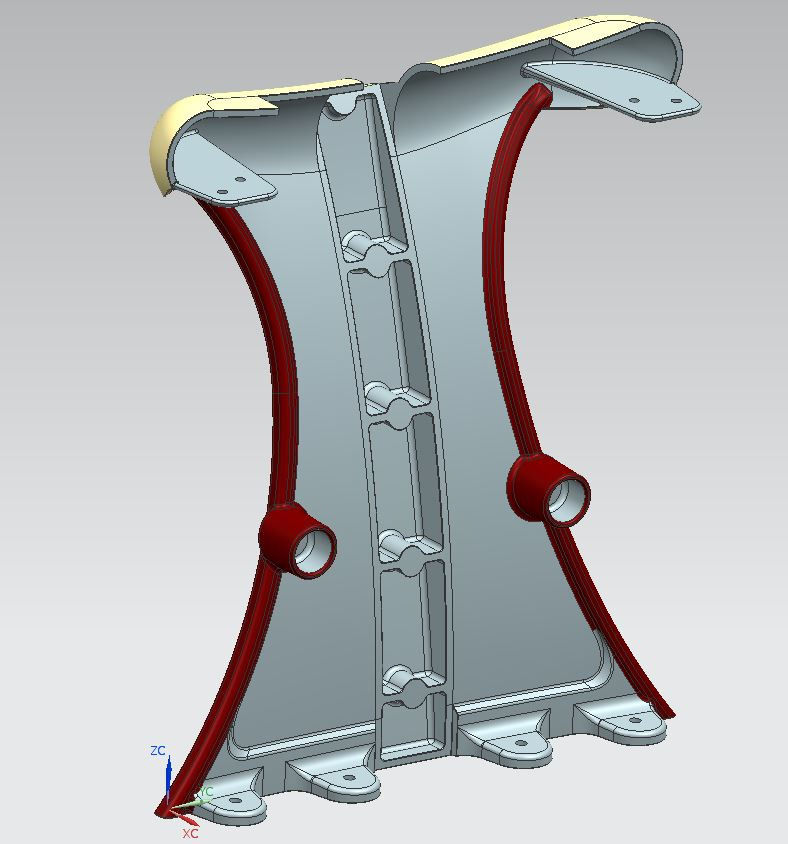
3D scanning is not an instant panacea for re-creating items. In the digital world, a scan is known as a ‘dirty’ model – the scanner picks up every defect. Thus, it is only a reference.
Instead, a new ‘clean’ model is made, using the scan, but developing it using new spines, arc or lines. These are dimensioned accurately where possible to known or measured dimensions. Clean, ‘Class-A’ surfaces are developed from these sketches, from which a solid model is ‘sewn’ together, and further details added in CAD.

Parts are modelled in CAD either individually, or ‘in-place’, and assembled into sub-assemblies in a ‘working assembly’. Finally, a master assembly is put together.
2D workshop drawings can then be made from the CAD information showing anything that might be needed. This can be either of a single part, or the full assembly.
3D information can also be sent to CNC* programs for developing tool paths to machine items out of solid, or 3D printers to make plastic patterns for lost-wax castings.
*CNC = Computer Numerical Control - computer controls the cutting equipment.

The virtual model is identical to the actual assembly. John Millar, shown here, is fitting an original side casting to a CNC-cut side pillar.
The most challenging task for this process is matching up sometimes very variable original castings with precision machined items. In the case of the trailer, the fit of the seat base casting to a new side pillar, and then to an original window and side panel slide housing, and to new roof bows and filler pieces, with original window receiver castings was the real test.

The last item to be modelled in CAD was the end bulkhead seating. This is a delicate assembly of red-cedar and ash, curved to the spine, fitted between the sliding door and the original seat armrest.

The vertical rails for the end seats were CNC cut, but each seat slat was hand cut and bevelled. Red Cedar is given a stain of ‘medium mahogany’. The finish used is Awlgrip Awlwood marine aliphatic clear.
Each slat is fitted with reproduction square drive brass oval headed cut-thread wood screws, as they were in 1922.
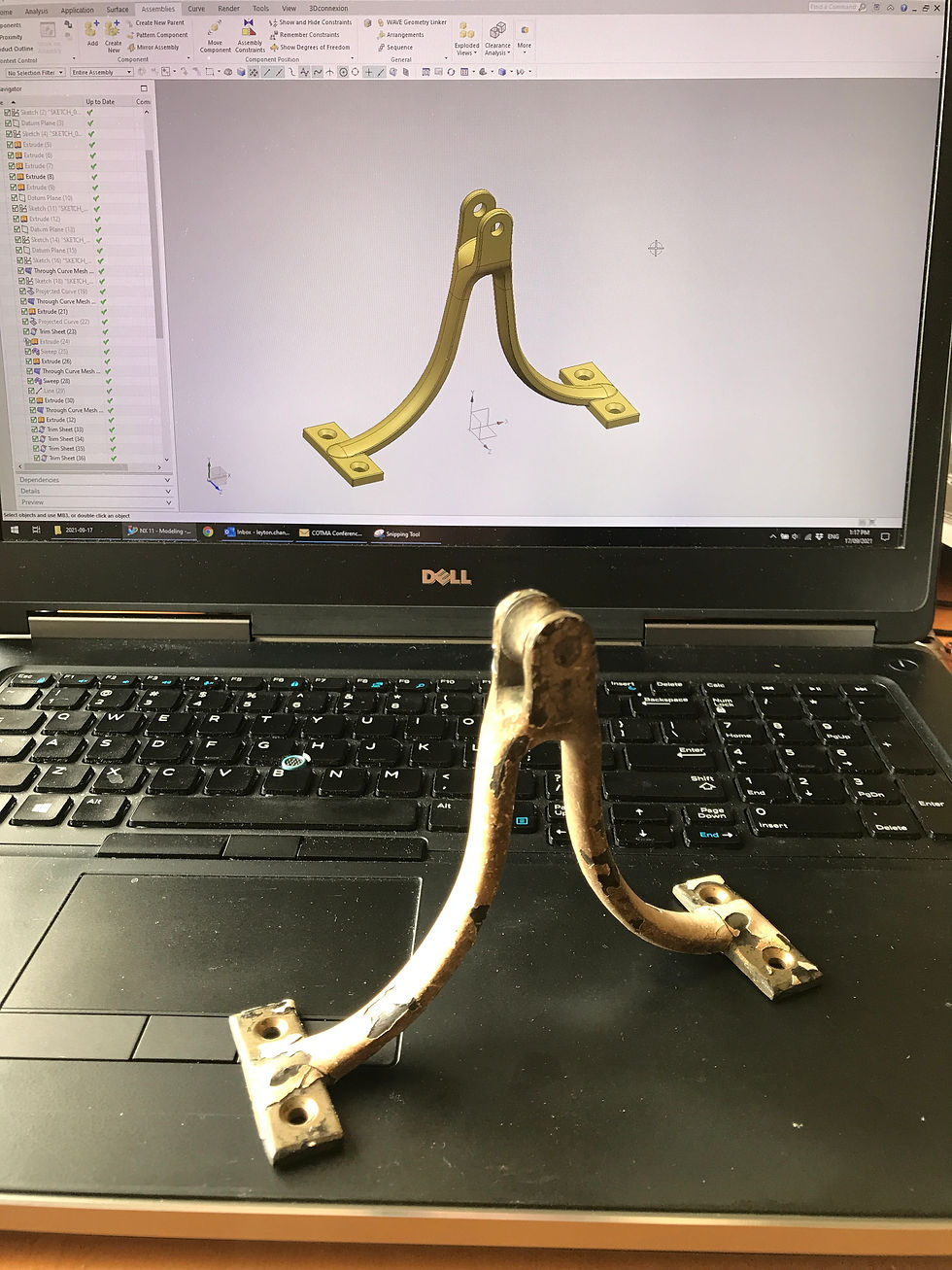
Dozens of small parts were modelled in CAD from, in some cases, single examples sent up on loan from the Tramway Historical Society in Christchurch.
This is the bell cord hanger bracket, a bronze casting for which no examples came with the trailer. Hole positions lined up perfectly with the remnant timbers.
The part was 3D printed in ABS [Acrylonitrile Butadiene Styrene] plastic, and an investment cast in bronze by Supreme Steel Ltd in Auckland. Each item was machined in-house at MOTAT, fettled, blocked-in, buffed and lacquered.

Seat bases were re-manufactured from American white ash, selected straight-grain quarter-sawn stock for stability.
These were rough machined, fitted together at MOTAT, then sent to Jackson Electrical Ltd in Onehunga to be CNC machined to the 3D file. Finishing was done in-house at MOTAT.

Bronze castings (side pillar grab rail fittings) in the process of fettling, blocking-in, polishing and buffing.
All matching wood screws are silicon-bronze, oval or flat head countersunk slotted cut-thread screws, buffed and lacquered.

December 2022, the side pillars, cantrail and front framing is in place. Roof bows are in the process of being test fitted by Andrew Garratt and John Millar. These were subsequently re-adjusted to within 2mm of string lines run the length of the car.
Handbrake standards have also been fitted at both ends. These are handwheel operated with an ‘Ackley’ quick take-up mechanism for the brake chain. These assemblies were manufactured by the Heritage Tramways Trust in Christchurch.

March 2024. Nicholas Shah fits each steam-bent Douglas fir roof ‘stick’ to temporary formers to make up the end canopies. This work was the most time-consuming and skill-taxing part of the build. No CNC work here.
Each stick is steam-bent spar-grade quarter-sawn timber, tapered, profiled with lap and vee. Bronze nails are used to secure them to the end bulkhead beam, roof bows and rim timbers. The internal finish is satin Awlwood clear.
The top of the roof is hand-planed and sanded to fair, primed/sealed with clear Durepox. A light skim of micro-balloon filler is applied to further fair the roof, followed by a stretched single-piece 12-oz/yard cotton duck canvas. The top-coat is MarineShield 2-part flexible UV resistant polyurethane coloured grey to match the original remnants.
Traditionally all the paints, bedding and sealers were white-lead with various pigments mixed in linseed oil.
Time for signwriting. Even the lining and striping was 3D modelled in CAD.
The paint scheme is unique to Wanganui, maroon and cream with gold-leaf lining edged with blue and black, shaded fleur-des-lis.

The paint system is Axalta Cromax 2-part polyurethane Resene ‘traffic’. An identical clear coat is applied over the signwriting to protect it.

Detail showing original corner fleur-de-lis panel in shaded gold leaf, edged with black and lined with white.

Hand-tracings were done of the original panel, then digitised in CAD and applied to the 3D model.
The car numbers were copied directly from the original end apron panels by the signwriters (Kieth Ellis, Osmand Signs)

August 2025. Kieth Ellis, Osmand Signs paints the black edging on the gold leaf border in One-Shot sign-writing enamel.
The background maroon had been sanded back to 600g satin prior to sign-writing commencing. There are six panels on the trailer all requiring this work to be skillfully applied.

November 2025. Sitting down on the job at last! [Left to right.] Nicholas Shah, John Wolf, Tony Messenger, Leyton Chan, Bruce Pullar and John Millar.
Both Johns were given the task to hand-fit the new seat base timbers to the original side castings. Each one is unique. The temporary jig of ‘pink wood’ framing timber allows uniform set out of the seating.

Night photo, April 2025. Showing the artistry of Nicholas Shah’s coachwork and interior joinery. One original panel at each end (the right-hand panel) survived and were restored and refitted. The raised and fielded mottled New Zealand kauri panels are rare today. Framing timber is Australian red cedar, known as ‘red gold’. These show off Australasia’s two premier cabinet timbers, a combination not found anywhere else in the world.

Night photo, April 2025. Book-matched mottled kauri veneer extends the superb craftsmanship into the centre ceiling panels. The veneer was laid up on vacuum formed ‘synply’ (a synthetic veneer) by Circa Marine in Whangarei, and finished at MOTAT.
Lighting is 24V incandescent ‘pygmy bulbs’, each bulb protected by its adjacent bell cord hanger.

The coat of arms for the Wanganui Borough Corporation.
An original water-slide transfer was saved by the late tramway historian Graham Stewart MNZM. The arms are from the Barons Petre of Essex. The 11th Baron was Chairman of the NZ Company. The English settlement at Wanganui was originally named Petre. The motto says ‘nothing without God’.
The trailer is perhaps the only place you will see this coat of arms today, as the present Whanganui district memorial bearings are slightly different.

Sunday 22nd March 2026 saw the launch of the finished product - a restored Wanganui Corporation Tramways electric tram trailer. Restoration of this quality is neither a simple task nor one that can be accomplished by one person. Before the official part of the launch ceremony, those who had been involved with No.21’s restoration project stand proudly in front of the trailer.
o o o O O O o o o
Gonville & Castlecliff Tramway Board, later Wanganui Corporation Tramways No.100

.In 1910 ex-Sydney Baldwin Steam Tram Motor No.100 was shipped to Wanganui to work on the construction of the electric tram line from Gonville to Castlecliff. Here we see No.100 on a works “train” unloading materials for the building of the line.

For three months in 1920, Wanganui’s electric tramway network was crippled by a power supply failure that left the town’s electric trams unable to operate. As a temporary solution, steam tram motor No.100 was brought back into service and coupled to electric tram trailers. This improvised arrangement maintained a skeleton passenger service between Wanganui and Castlecliff until power was restored. In this photograph, No.100 is seen hauling two trailer cars at Castlecliff.

The last week of tram operation in Wanganui was in September 1950. On the closing weekend No.100 towed trailers Nos.20 and 22 giving the public rides up and down Victoria Avenue.

After the closure of the Wanganui Corporation Tramway system No.100 was sold to a scrap merchant in Wanganui. An attempt was made by a group in Sydney to repatriate the engine, however due to lack of funds this was unsuccessful. Upon seeing this failed attempt to save No.100, The Old Time Transport Preservation League [OTTPL] bought No.100, and moved it to Auckland. Here, we see

Ian Stewart and Merv Sterling posing with the tram in 1958 prior to its move to Auckland.
After arrival in Auckland No.100 was stored at the back of the Auckland Transport Board’s Manukau Road Workshops for a number of years. In 1971 No.100 finally arrived at MOTAT. The OTTPL had merged with other groups to form MOTAT which opened in 1964.

After seven years of work, No.100 was steaming again. Seen here in January 1978 with Ian Mison at the controls, No.100 is travelling down the museum’s inner tramline closely followed by Auckland Streamliner No.253.
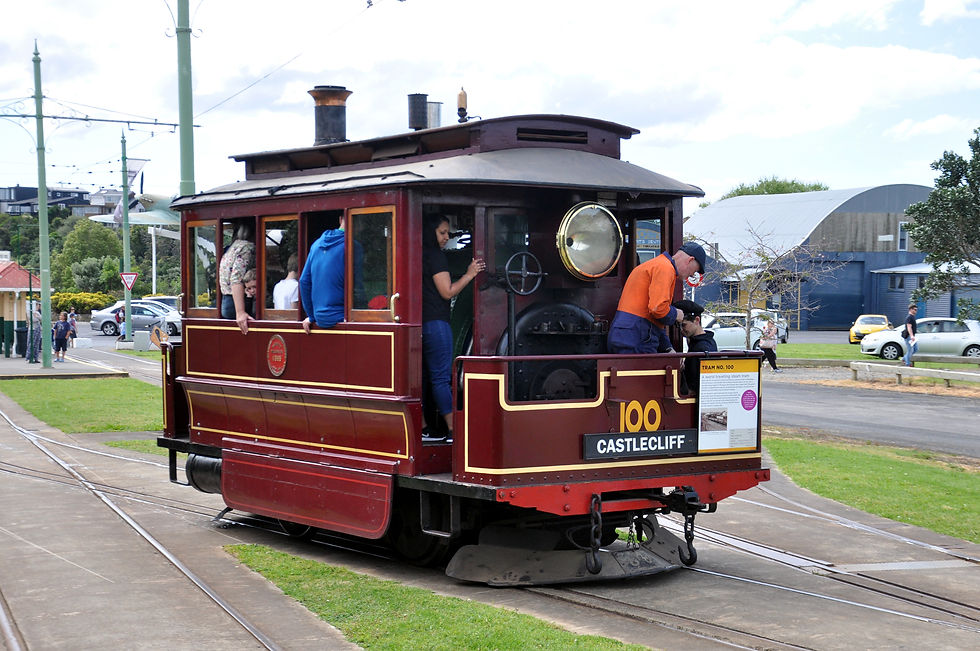
Wanganui Corporation Tramway No.100 as she appears today. Over her years at MOTAT, she has undergone several restorations to maintain her in operating condition.
A notable change came in 2023, when No.100 transitioned from coal firing to using compressed wooden briquettes as fuel. These briquettes are produced by compressing forestry waste into small log-shaped blocks a few inches long.
o o o O O O o o
Wanganui Corporation Tramways No.10

In the first quarter of the twentieth century the postcard performed the same function in society that email and text messages do today. As well as conveying a message or greeting, postcards were seen as a way of announcing to ‘the world’ the advances that had taken place in a local community. Here we have a wonderful postcard from Frederick George Radcliffe showing Wanganui Corporation Tramways [WCT] No.10 in Victoria Avenue at the Ridgway St junction with passengers disembarking and the crew readying No.10 for another trip to Gonville via Alma Rd.

WCT No.10 is a four-wheel single truck tram built by Boon & Company of Christchurch in 1912 to a design commonly known as ‘California Combination’. This design provided both enclosed and open seating allowing women and children to travel in the enclosed centre saloon whilst men and teenage boys travelled in the open sections at each end, which also provided non-smoking and smoking accommodation on the tram. This 1913 image shows No.10 in Rangiora Street at the terminus of the Castlecliff route with her smartly-uniformed crew and several passengers; the beach and Tasman Sea can be seen in the background.
![Image: Scanned image of photo of WCT Nos.10, 22 & 21 on the depot fan from page 15 Wanganui Corporation Tramways 1908-1950 by Ron Alexander, December 1940, Photo by JW [Wallace] Sutherland, Rephotographed by M Kilpatrick.](https://static.wixstatic.com/media/155cea_bf704f556dc546ca95d2a99726442048~mv2.jpg/v1/fill/w_980,h_471,al_c,q_85,usm_0.66_1.00_0.01,enc_avif,quality_auto/155cea_bf704f556dc546ca95d2a99726442048~mv2.jpg)
WCT was faced with increased passenger loads within a few years of tramway operation beginning. The solution WCT decided upon was the use of trailer trams which would be hauled behind their electric trams. The trailers were built by Boon & Company of Christchurch in two batches with trailers Nos.20, 21 & 22 in the second batch, which arrived in Wanganui in the early 1920s. This wonderful December 1940 image by J W [Wallace] Sutherland shows WCT No.10 electric tram with two trailers, WCT No.22 and reportedly No.21, on the tracks which formed the depot fan leading to the tram barn. It is most likely that WCT tested both Nos.10 & 12’s (a sister tram to No.10) capability of hauling trailers due to increased passenger loading during WW2.
![Image: WCT No.10 at Taupo Quay Depot, September 1948, Photo by WW [Bill] Stewart, Graham Stewart Collection.](https://static.wixstatic.com/media/155cea_c08222a337f34e56b5da5baa5acebfe5~mv2.jpg/v1/fill/w_980,h_583,al_c,q_85,usm_0.66_1.00_0.01,enc_avif,quality_auto/155cea_c08222a337f34e56b5da5baa5acebfe5~mv2.jpg)
A wonderful three-quarter view of WCT No.10 outside the tram barn on Taupo Quay was taken by WW Stewart in September 1948.
Two years before tramway operations ceased No.10 was still available for service, though looking a little tired due to reduced maintenance after the introduction of the ‘Takapuna’ trams. The Takapuna trams were large bogie one-man operated trams that were introduced into service from 1930 onwards. They had been converted from trailers to electric trams. The trailers had been purchased by WCT from the former Takapuna Tramway and Ferry Company which ceased running steam tram motors and trailers on Auckland’s North Shore in 1927.

When the trams ceased in late 1950, Wanganui Corporation disposed of the trams by removing the bodies from the trucks and selling the mechanical parts to scrap metal dealers and the bodies to whoever wanted them. Some bodies became garden sheds, some storage sheds and some baches. No.10 came to rest on a property outside Whanganui where it remained until the mid-1960s when it was purchased and donated to MOTAT. A wonderful image of No.10 in a bucolic setting showing it to be in remarkable condition after sitting outside in all weathers for 15 years.

On 22nd April 1967, WCT No.10 and No.21 arrived at MOTAT having been railed from Whanganui to Morningside and trucked from there to Western Springs. The building in the background is now the fire station, and the entrance used by the truck is now the gate used by the trams to access the tramway from M1 to M2. No.10’s body was lifted by crane from the truck’s trailer and placed on the tram-jacks and beams that can be seen in the foreground. Later No.10’s body was placed on temporary axle and wheel sets and then placed on the track.

Late 1967. WCT No.10 on its temporary axle and wheel sets on the tracks on the curve near the Engineer’s Cottage. This image clearly shows the design layout of a California Combination tram: enclosed saloon and open sections. Despite many years in the open, No.10’s body is in remarkable condition - both the crest of the Wanganui Corporation is faintly visible on the upper rocker panel and the words “Corporation Tramways” on the
lower rocker panel.

After a number of years stored in the open at MOTAT1, WCT No.10 was placed in undercover storage at the former Government Stores buildings at Sylvia Park as seen in this image by Leslie Stewart taken late 1979 or early 1980.
Today No.10 is in safe storage at MOTAT3 awaiting restoration. At some time in the future, No.10 will be able to re-enact the Sutherland image of 1940 and be coupled to WCT electric tram trailer No.21.
o o o O O O o o o


Comments