
MOTAT Society Excursion : Visit to MOTAT Tramway
By Mark Kilpatrick

A small group of Society members gathered at the M1 site of the Museum of Transport and Technology, on Tuesday 17th February 2026, to have a ‘behind-the-scenes’ look at the Museum’s tramway. The visit involved a tram ride to the Motions Road corner to view the new passing loop track, a visit to the tramway mechanical workshop and to the woodwork workshop to view Wanganui* trailer 21. Travel from M1 to Motions Road corner was provided by Auckland tram 44 of 1906. When Auckland tram 44 came to MOTAT it was just a body and underwent a full body overhaul and a complete replacement of all mechanical fittings: 4-wheel truck, electrical control equipment and hand-operated brake system.
* At the time when trailer 21 was in operation in Whanganui the Corporation’s name was Wanganui Corporation Tramways.

Work on replacing the 1980-81 Motions Road passing loop was undertaken in the second half of 2025. The original passing loop and back shunt (siding) was uplifted and replaced with a better positioned passing loop. Mr James Duncan, Tramway Project Manager, is seen explaining that the new dual-gauge paintwork was manufactured by Pražská strojírna a. s. in Praha, Czechia, using a solid block of steel which was cut and shaped with high-pressure water CnC (Computer Numerical Control)). The Museum’s tram track is dual gauge to accommodate both standard gauge trams from Auckland, Melbourne and Wanganui tramways and the 4-foot gauge trams from Wellington. Not only was the Motions Road loop replaced in the track replacement programme in 2025 but so was the tramway crossing of Motions Road, near to the Zoo tram stop, and the s-bend beside the main vehicle entrance to Western Springs College. The rail used in the original track was second-hand rail and in the last 30-plus years had worn and became life-expired.
The tramway’s mechanical workshop is responsible for mechanical maintenance and refurbishment and rebuilding of major mechanical components such as the trucks on which the trams ride. James can be seen telling the group that Auckland tram 248 was one of the very first trams to be preserved by the Old Time Transport Preservation League which eventually formed the group that started MOTAT back in 1964. Behind James can be seen Wellington double-decker tram 47 which came to MOTAT in late 1964 after the closure of the Wellington tramway system.
The last and the replacement: Wellington tram 257, one of the class of trams known as a Fiducia, was one of the last trams built for the Wellington system and entered service in 1950 and was withdrawn in 1964 and arrived at MOTAT in late 1964. Auckland trolleybus 50 entered service in 1953 as a replacement vehicle for the Auckland trams. On some Live Days Auckland trolleybus 50 operates within the museum grounds and delights the public who remember what trolleybus travel was like, as well as those who are experiencing a trolleybus for the first time.
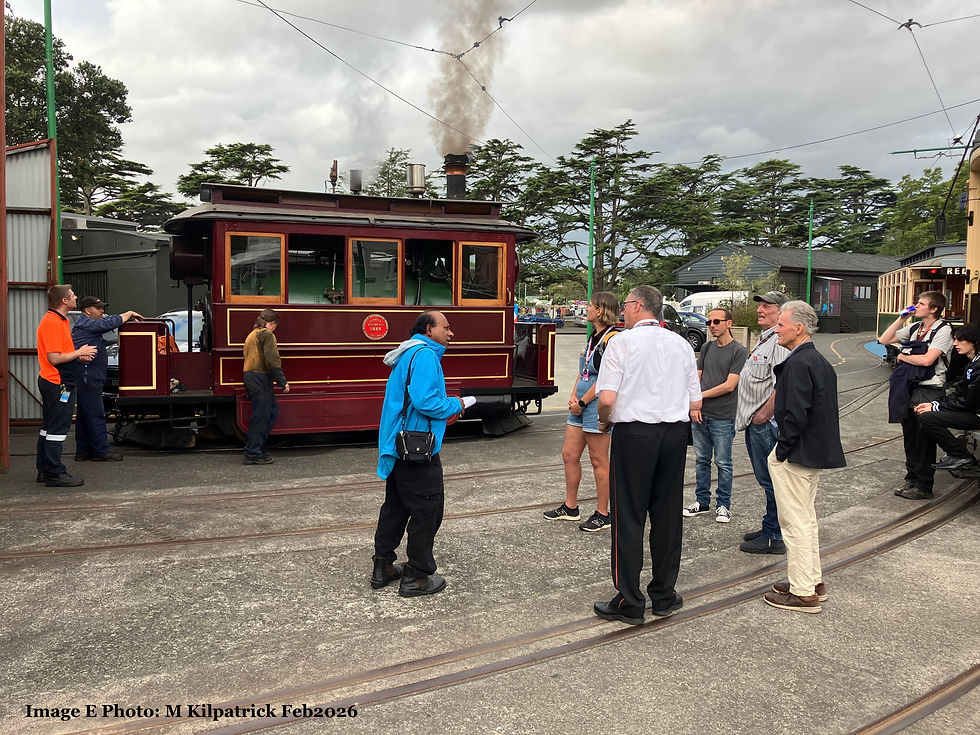
Before visiting the woodwork workshop, the group saw Baldwin Locomotive Works Wanganui steam tram 100, formerly New South Wales Government Tramways 100, of 1891. Steam tram 100 came to Wanganui to help with the building of the electric tramway extension from Gonville Junction to Castlecliff Beach giving not only easy access to the beach but also to encourage the residential development of the Castlecliff area.
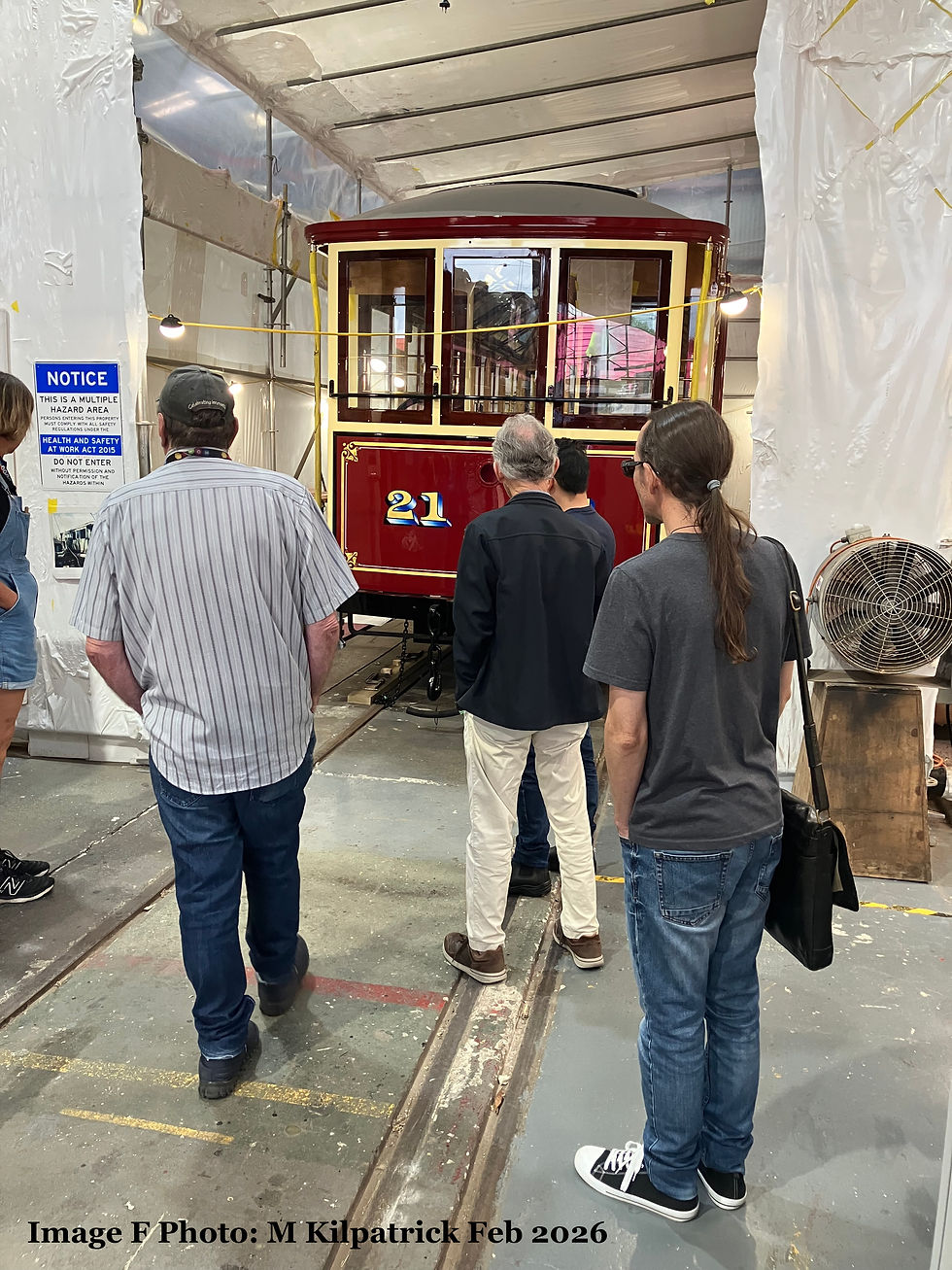
The highlight of the visit was viewing Wanganui tram-trailer 21 which has undergone a complete restoration and rebuild of both the wooden body and the mechanical truck and brake system. Wanganui had six trailers and trailer 21 is the only survivor. Built by Boon and Co in Christchurch as a convertible trailer which allows for the lower side panels and the upper side window panels to slide up into the ceiling space to provide an open trailer with side entrance for warm summer days. During more inclement weather, both the lower side panels and the upper side window panels can be left in place to give passengers a dry ride. If ventilation is required, the upper side window panels only can slide up into the ceiling space.

A side view of Wanganui tram trailer 21 shows the trailer with both lower and upper side panels retracted into the ceiling space and the full-length step which gives access to the 2+2 seating in the main saloon. Just below the roof gutter can be seen a safety barrier which drops to seat height to discourage passengers from boarding on the off-side of the trailer when operating in summer mode.


Comments